
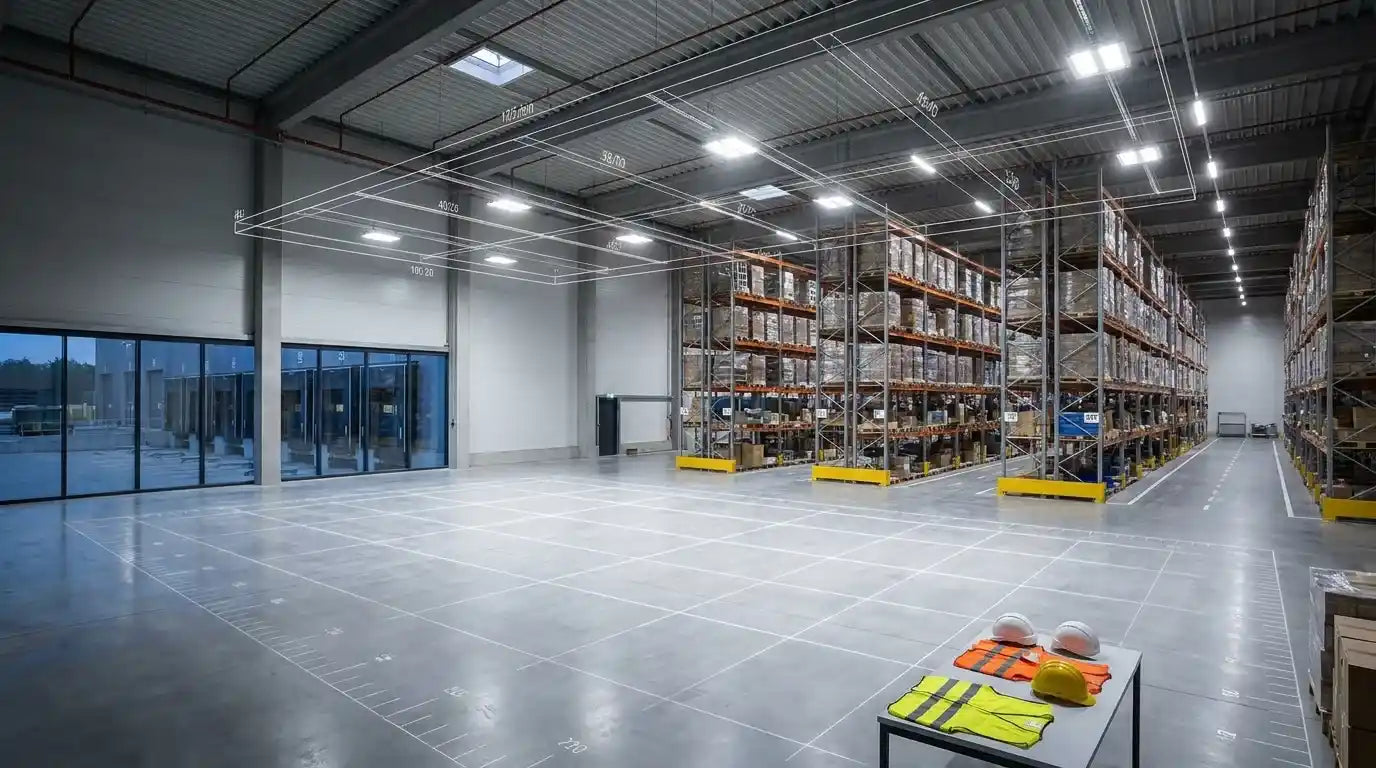
If you are lighting a warehouse, factory, workshop, or other large commercial space, you may be asking: "How many high bay lights do I need?" The answer depends on more than the size of the room. Ceiling height, fixture lumens, desired brightness, beam angle, spacing, work activities, and obstructions all affect the final number.
A basic calculation can provide a useful estimate, but the best result comes from combining a high bay light calculator with a properly planned fixture layout. This guide explains how to calculate the number of high bays you need and how to avoid common lighting mistakes.
Quick Answer: How Many High Bay Lights Do I Need?
The simplest lighting calculation is:
\[ \text{Number of Fixtures} = \frac{ \text{Floor Area} \times \text{Required Foot-Candles} }{ \text{Lumens per Fixture} \times \text{Coefficient of Utilization} \times \text{Light Loss Factor} } \]
For metric projects, you can use the equivalent lux formula:
\[ \text{Number of Fixtures} = \frac{ \text{Area in m}^2 \times \text{Required Lux} }{ \text{Lumens per Fixture} \times \text{Utilization Factor} \times \text{Maintenance Factor} } \]
This calculation gives you a starting estimate. You must still check whether the lights are correctly spaced and whether they provide enough illumination at the floor, shelves, aisles, and work surfaces.
For general warehouse storage and circulation areas, lighting targets may range from approximately 10 to 30 foot-candles, depending on the activity and the required visibility.

What Determines the Number of High Bays?
1. Floor Area
The larger the space, the more light fixtures you will generally need. Measure the length and width of the area you want to illuminate.
Floor Area=Length×Width
For example, a warehouse measuring 100 feet long and 60 feet wide has:
When your building has separate zones, work out the area for each zone separately. The light level for each area may vary, such as a storage area, packing station, loading area, and even a manufacturing section.
2. Mounting Height
Mounting height is the distance from the light fixture to the working plane. For a fixture mounted to a ceiling that is 25 feet high and a work surface that is 3 feet above the floor, the effective mounting height is about 22 feet. The higher the object, the wider the spread of light, but the less intense the light. For high mounted fixtures, lumen output is important and the beam angle must be right. Most often, LED high bays will be used in a range of 15 to 30 feet above the ground, but specialized fixtures can be mounted higher.
3. Required Brightness
Brightness levels vary from activity to activity. Businesses storing large quantities of items in a warehouse do not require the same level of lighting as a warehouse for detailed assembly operations or for people to read small labels on items.
Typical planning ranges include:
These are NOT requirements, but starting points. Also take into account local regulations, workplace standards, safety procedures and the type of work being carried out.
4. Fixture Lumens
Lumens measure the amount of light produced by a fixture. Wattage measures energy consumption, so wattage alone cannot tell you how bright a high bay will be.
Two 150-watt fixtures may produce different lumen outputs because of differences in LED efficiency, optical design, driver quality, and construction. When comparing high bays, check:
- Delivered lumens.
- Lumens per watt.
- Beam angle.
- Color rendering.
- Warranty.
- Rated lifetime.
- Photometric performance.
- Dimming and control compatibility.
As a general guide, lower mounting heights may use fixtures producing around 10,000–15,000 lumens, while higher ceilings may require 20,000–40,000 lumens or more. The correct output depends on the space and layout.
5. Light Loss and Utilization
Light from a fixture does not always land on the work surface. A portion gets taken up by the ceiling, walls, shelving, floor, and other parts of the space. Dust buildup and normal aging also lower the output as time goes on.
Two common factors are:
- Coefficient of utilization: the share of fixture light that actually reaches the work area.
- Light loss factor: The expected reduction in useful light caused by dirt, depreciation, and operating conditions.
For a quick rough check, many simple lighting estimates pick a utilization factor near 0.70 to 0.80. They also use a light loss factor of around 0.80 to 0.95. A lighting specialist may choose different figures after looking at room reflectance, the planned cleaning and relamping timing, and the fixture's own data.
How to Calculate the Number of High Bays
Get the following information about your room.
Step 1: Measure the Room
Record:
- Length.
- Width.
- Ceiling height.
- Fixture mounting height.
- Work-plane height.
- Locations of racks, machinery, doors, skylights, and obstructions.
For a rectangular building, multiply the length by the width to determine the floor area.
Step 2: Select the Lighting Target
A target should be selected according to the use of the space. A general storage area might need fewer lights than order picking, manufacturing, or quality control.
Never choose the target based on the number of fixtures it yields, as it is not desirable to choose the smallest target. Good lighting is essential to avoid shadows and to make work more efficient and easier for workers to locate labels, obstacles and hazards.
Step 3: Find the Fixture's Lumen Output
Follow manufacturer's published lumen rating. Don't use only wattage or phrases like "equivalent to 400 watts".
For example, assume you are considering a high bay rated at 30,000 lumens.
Step 4: Apply the Formula
Suppose you have:
- Area: 6,000 sq feet.
- Target illumination: 30 foot-candles.
- Fixture output: 30,000 lumens.
- Coefficient of utilization: 0.75.
- Light-loss factor: 0.90.
Your starting point will be about 9 high bay fixtures. But 9 fixtures may not result in a suitable layout. When the building is long and narrow the fixtures may require to be installed in multiple rows. The final design may need more fixtures and lower output to obtain a more uniform design.
Step 5: Check Spacing and Uniformity
After calculating the estimated number of high bays, place them on a layout. Check whether the light reaches:
- The center of each aisle.
- The tops and sides of storage racks.
- Workstations.
- Loading and unloading zones.
- Areas between fixtures.
- Edges and corners of the building.
A room can have an acceptable average light level but still contain dark spots. Uniformity is especially important in warehouses and production facilities where workers move between bright and dim areas.
High Bay Light Spacing Guide
The spacing will vary based on the height of the mounting, the type of fixture, the angle of the beam, and the brightness level desired. A typical approach to starting is to use a ratio of spacing to mounting height of about 1.0-1.5. If the mounting height is 20 feet, for instance, the initial spacing could be 20 to 30 feet. This is only a planning guideline. The maximum practical spacing should be determined by the manufacturer's photometric data.
Typical starting points include:
| Mounting height | Approximate spacing range |
|---|---|
| 15–20 feet | 12–20 feet |
| 20–30 feet | 18–30 feet |
| 30–40 feet | 25–40 feet |
Narrower beam angles may necessitate closer spacing, wider distributions may cover more area. Linear high bays installed over aisles can have different spacing requirements than those installed in open spaces (UFO high bays).
The first row of fixtures should also be positioned carefully. Placing fixtures too close to walls can waste light, while placing them too far from the walls may leave the perimeter underlit.
How Many Lumens Should a High Bay Have?
There is no single lumen rating that works for every building. The correct output depends on the mounting height and the space's lighting target.
A general starting guide is:
- 10–15-foot mounting height: approximately 10,000–15,000 lumens.
- At 15 to 20 feet above the floor, expect around 15,000 to 25,000 lumens.
- When the height is 20 to 30 feet, the range is usually about 20,000 to 35,000 lumens.
- If you go higher than 30 feet, it is common to see 30,000 lumens or more. This depends on the specific use.
These ranges are not a substitute for a photometric plan. A 20,000-lumen fixture with a suitable beam angle may outperform a higher-lumen fixture with poor distribution for a particular layout.
UFO vs. Linear High Bay Fixtures
UFO High Bays
UFO high bays are small, round lights. You often see them in open warehouses, workshops, gyms, and plant spaces. They tend to perform best when the lights are spaced in a regular layout. The ceiling should also be fairly clear, with few things blocking the light.
Their performance depends heavily on:
- Beam angle.
- Mounting height.
- Reflector or lens design.
- Spacing.
- Glare control.
Linear High Bays
Linear High bays are long fixtures that work well in aisles, production lines, retail warehouses, and areas where light needs to follow a specific direction.
They can be useful for:
- Narrow aisles.
- Long workstations.
- Continuous production areas.
- Rack-supported storage layouts.
- Facilities requiring more controlled light distribution.
The best option is not determined by fixture shape alone. Compare the photometric distribution and match it to the way the building is arranged.
High Bay Lighting Mistakes to Avoid
Choosing by Watts Alone
Watts inform you about electrical consumption but not about the amount of useful light delivered to the floor. Never forget to compare delivered lumens and light distribution.
Ignoring the Work Surface
A light fixture may look bright when viewed from the floor but provide inadequate illumination for a workbench or low shelves. Make sure that you calculate light on the working surface.
Spreading Fixtures Too Wide
Over-spaced fixtures might cause some dark spaces in between your fixtures. Even though foot-candles might be adequate when looking at their average, inadequate spacing might have some adverse consequences on performance and safety.
Using the Same Layout Everywhere
Storage, picking, packing, manufacturing, and inspection areas often have different requirements. Use separate calculations for each zone.
Forgetting Existing Daylight
Use of windows and skylights can help to lessen the use of electric lighting during the daytime. Utilize techniques such as daylight harvesting, occupancy sensing, dimming, and scheduling to reduce usage of energy.
Overlooking Glare
The light fitting that emits too much light or has improper beam angle could cause glare to the employees and forklift operators. Opt for the proper optical systems, diffusers, reflectors, and mounting location.
When Should You Use a Professional Lighting Plan?
A professional photometric layout is strongly recommended when:
- The ceiling is more than 25–30 feet high.
- The facility contains tall racks or complex machinery.
- Workers perform detailed or safety-critical tasks.
- The building has irregular dimensions.
- Energy consumption must be minimized.
- You need documented foot-candle or lux results.
- You are replacing an existing lighting system.
- Local codes or project specifications require verification.
A photometric plan can show fixture locations, predicted illumination, minimum and maximum light levels, uniformity, glare considerations, and energy usage. It can also prevent the expense of buying too many or too few fixtures.
Most Common Questions
How many high bay lights do I need for a 10,000-square-foot warehouse?
There are no universally applicable answers because the number of required fixtures in a warehouse of this size may depend on such factors as ceiling height, brightness level needed, lumens per fixture, arrangement of racks, and spacing.
What is the required distance between high bay lights?
As a basic guideline, it is recommended to install light fixtures at the distance equal to 1.0–1.5 times their mounting height from each other; however, actual distance depends on a beam angle.
Can I use a high bay light calculator?
Yes, using a high bay light calculator may help you to get an approximate estimate by enterinfixture'sm dimensions, required level of brightness, lumens of a fixture, and mounting height
Is a 100-watt high bay enough?
It depends on the fixture’s lumen output and mounting height. One 100-watt LED high bay may produce considerably more or less light than another. Check lumens, efficacy, beam angle, and the appfixture'sbefore selecting it.
Should high bays be installed in rows?
That can work well when you need to line up lights for aisles, shelves, and production areas. Some open warehouse spaces use a grid instead. The right choice comes from the room layout and where racks, machines, and workstations sit.
Does that mean that the more high bays, the better?
Not quite. Though more lights increase consumption, probably making everything brighter, they may also increase glare and run up maintenance costs. Besides, they may not even solve the problem of sufficient illumination. It’s essential to seek a well-distributed light, rather than the maximum brightness.
Final Checklist
When buying a number of high bays, please be sure to check the following:
- Measure the exact floor area.
- Determine the actual mounting height.
- Identify the work activities in each zone.
- Set the required foot-candle/lux level.
- Use lumens instead of watts for fixtures’ output.
- Utilization and maintenance coefficients are necessary.
- Plan spacing, rows, beam angles, and fixture positions.
- Account for racks, machinery, walls, and daylight.
- Check glare and uniformity.
- Request a photometric layout for complex projects.
Conclusion
The number of high bay lights required is not only based on room size, but also on the overall lighting design. Given the floor area and brightness requirements, determine the approximate number of high bays, then check out the spacing, fixture output, beam angle and working-plane illumination. A high bay light calculator is helpful for planning purposes but a professional photometric study is more reliable, particularly for taller warehouse, factories or facilities containing racks or areas of fine work. The right design will provide consistent, focused light without wasted fixtures, light and glare.