
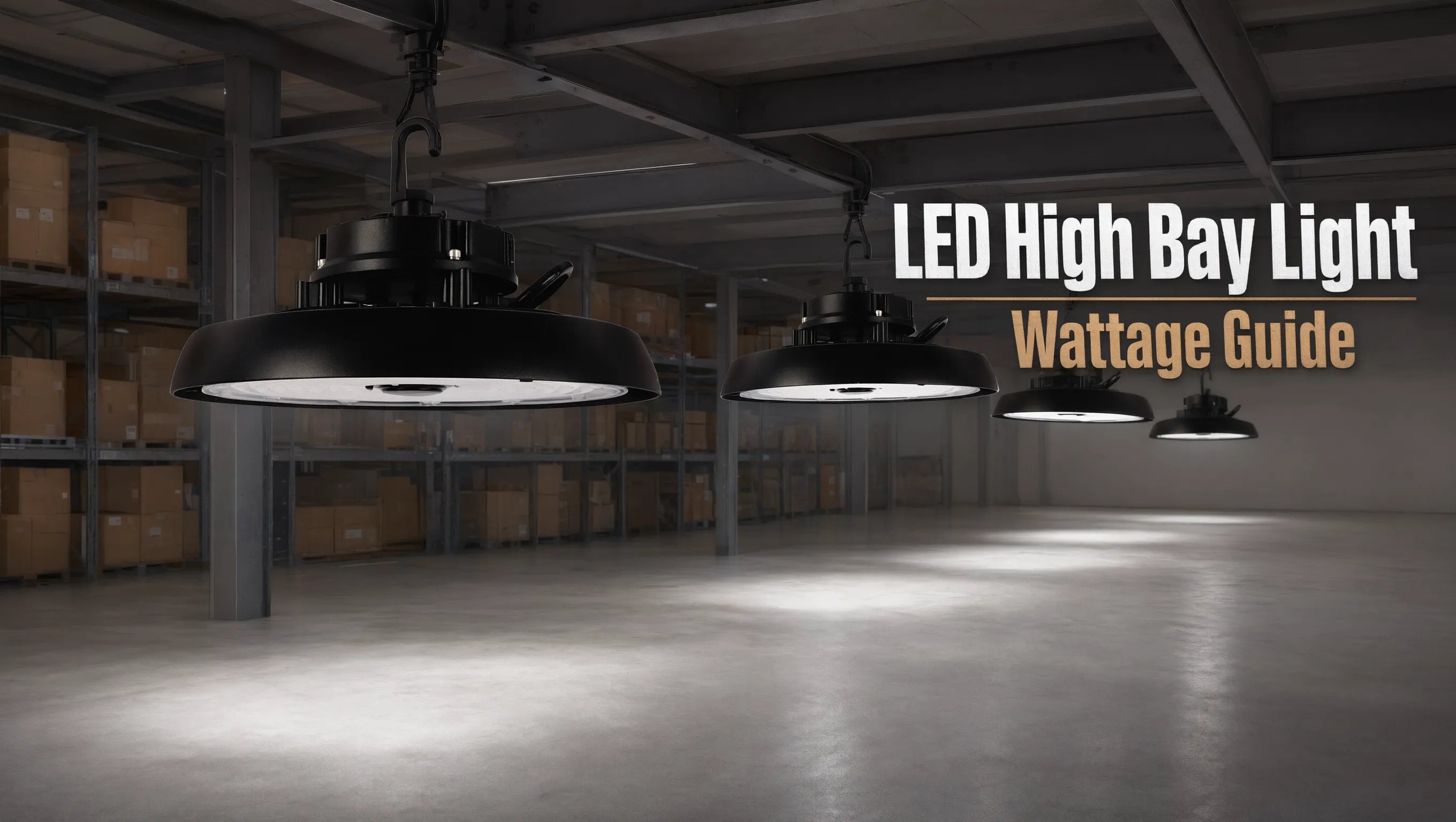
One of the most frequent and expensive errors for Commercial and Industrial LED Lighting projects is choosing the wrong Wattage. If the ceiling is too low, the work areas will be dim, which will affect safety and productivity. If you go too high, you are paying unnecessarily high energy bills for energy output your space never required.
This high bay wattage guide explains the 4 most common LED high bay wattages: 100W, 150W, 200W and 240W LED high bay, lumen output, ideal ceiling heights, real world applications, and equivalent HID replacements. The idea here is to match your Wattage to your space, not the other way around, whether it's a retrofit or a spec-out.
Why Wattage Alone Doesn't Settle the Decision
Before comparing wattages, it helps to understand what Wattage actually tells you and what it doesn't.
Watts measure how much power a fixture consumes. They say nothing about brightness. That's where lumens come in. Lumens measure the total amount of visible light a fixture produces, and luminous efficacy (expressed as lumens per watt, or lm/W) tells you how efficiently a fixture converts energy into light.
The 200W high bay with 28,000 lumens at 140 lm/W is a completely different ball game than the 200W fixture with only 22,000 lumens at 110 lm/W, even though the wattage is the same. In addition to lumens, mounting height is important. Fixtures placed higher above the floor will spread out their light before it reaches the floor, thus lowering the foot-candle level. The difference in the amount of light reaching the floor level between a 150W high bay at 20' and a 150W high bay at 30' is quite noticeable. That's why it is always a good idea to check the ceiling height in any high bay wattage guide you use and tick the box.
Factors to Confirm Before You Choose a Wattage
Before jumping to the comparison, run through these four variables for your specific project:
Ceiling or mounting height
High bay fixtures are generally designed for ceilings at 15 feet and above. The higher the ceiling, the more output you need to maintain adequate foot-candle levels at floor level.
Space type and lighting standard requirements
The minimum light levels vary from environment to environment. Warehouses used for general storage typically require 10–20 foot-candles. Pick and pack activities require 30 foot-candles or higher. Manufacturing inspection areas can call for 50+ foot-candles. On any specification project, you should be able to refer to recommended foot-candle targets published by the IES (Illuminating Engineering Society).
Existing fixture replacement
When replacing an existing HID (high intensity discharge) lighting system, such as a metal halide lamp or a high pressure sodium lamp, LED high bay lighting does not necessarily have to match in Wattage. With LED efficacy more than 4 times greater than HID, it is possible to easily replace a 400W metal halide with a 150W LED high bay and maintain the same or higher light levels.
Spacing, layout, and fixture count
Sometimes, fewer fixtures at maximum Wattage may yield less uniformity than more fixtures with less Wattage. Don't make wattage decisions without taking fixture layout into consideration.

100W LED High Bay Reliable Output for Lower-Clearance Spaces
Lumen Output
Good 100W high bays produce about 12,000 to 14,000 lumens, and the efficiency of such fixtures varies from 120 to 140 lumens per watt. You should check the photometric specification sheet of your potential fixture, as inferior quality devices might not perform that well.
Ideal Mounting Height
Between 15 to 20 feet is usually recommended. Low Wattage fifty watt lights are generally suitable for environments that approach high bay as well as places that do not require a great amount of throughput.
Best Applications
Suitable applications include small warehouses, car repair workshops, loading bays, farms, agriculture storage rooms, and retail storage. If you install such lighting in a workshop or garage with ceilings of 18 feet high, it will perfectly fulfill its purpose.
HID Equivalent
The 100W LED high bay is a direct replacement for 250W metal halide, using 60 percent less energy.
Worth Noting
Such Wattage is good for cost-effective retrofitting of smaller spaces without extremely high ceilings. However, it would be wise to verify your foot-candle requirement before purchasing, as insufficient light can be an issue in assembly and inspection rooms.
150W LED High Bay The Most Versatile Option in the Range
If one Wattage earns the label of "commercial workhorse," it's the 150W high bay. It sits at a practical midpoint: enough output for a wide range of mid-size applications without the energy draw of the 200W and 240W tiers.
Lumen Output
A decent fixture of 150W typically sells at a range of 18,000 to 21,000 lumens at 120–140 lm/W efficacy.
Ideal Mounting Height
20 to 25 feet. This range covers the majority of standard commercial warehouses, distribution hubs, and large sports and recreation facilities.
Best Applications
The 150W high bay can be ideally applied in medium-sized warehouses, commercial parking venues, gymnasiums, indoor courts, and logistics centers. If you operate in a facility with a height of 22 feet featuring heaps of goods and some work of forklifts, this is precisely what most lighting designers recommend.
HID Equivalent
The 150W LED replaces approximately 400W metal halide, cutting energy consumption by roughly 62%.
Worth Noting
Because this Wattage is so broadly applicable, it's the most commonly stocked option which often means better pricing and shorter lead times compared to the higher wattage tiers.
200W LED High Bay Built for Large-Scale Commercial and Industrial Use
When a facility starts pushing past 25 feet in ceiling height, or when the floor area is simply too large for a moderate-output fixture to cover effectively, the 200W high bay becomes the standard specification.
Lumen Output
A good 200W high bay has a lumen output of 24,000 to 28,000 lumens, and the best models are 140 lm/W and higher.
Ideal Mounting Height
25 to 35 feet. This range covers the bulk of large-format commercial construction big-box retail, major distribution centres, manufacturing plants, and indoor athletic arenas.
Best Applications
For larger warehouses that are in use, high manufacturing areas, indoor event venues, and any area that requires more ceiling height and spacing distances, the 200W is the recommended size. It provides high foot-candles at the floor level, even at high mounting heights, and doesn't need an impractical fixture grid.
HID Equivalent
The 200W LED high bay replaces approximately 600–750W metal halide, delivering energy savings of around 65% or more depending on the legacy system being replaced.
Worth Noting
It's important to check compatibility of your dimming and controls at this Wattage. In spaces with irregular occupancy, many 200W high bays can be further dimmed to 0-10V and also accommodate the integration of an occupancy sensor, which can further increase energy savings.
240W LED High Bay Maximum Output for Industrial Heights
The 240W LED High Bay Maximum Output is designed for use in industrial applications. The 240W high bay is at the high end of the standard commercial range. It's there for one main reason: when ceiling heights are so high, that lower wattages do not provide sufficient light intensity at floor level.
Lumen Output
The 240W is the highest output of the three, with 29,000-34,000 lumens.
Ideal Mounting Height
Being between 35 to 45 feet or even higher, aviation hangars, steel fabrication factories, logistics terminals, and manufacturing facilities that have high ceilings are the ideal environments for this Wattage.
Best Applications
For facilities with crane systems, high-raked storage over 40 feet or production lines that need to be lit uniformly over very wide areas, the 240W high bay is worth considering. Seldom is it possible to light these areas with lower wattages without achieving poor light uniformity.
HID Equivalent
The 240W LED high bay replaces approximately 1000W metal halide a replacement that typically achieves energy savings of 75% or more, with dramatically reduced maintenance costs given LED's extended lifespan.
Side-by-Side Wattage Comparison
| 100W | 150W | 200W | 240W | |
|---|---|---|---|---|
| Lumen Output | ~13,000 lm | ~19,500 lm | ~26,000 lm | ~31,000 lm |
| Mounting Height | 15–20 ft | 20–25 ft | 25–35 ft | 35–45 ft |
| MH Equivalent | 250W | 400W | 600–750W | 1000W |
| Typical Application | Small warehouses, workshops | Mid-size commercial, gyms | Large warehouses, manufacturing | Industrial, hangars |
| Est. Energy Savings vs MH | ~60% | ~62% | ~65% | ~75%+ |

How to Calculate the Wattage Your Space Actually Needs
Instead of making a guess, you can use the following steps:
Step 1: Calculate the foot-candles you need. Use reference IES standards to your space type. General warehousing: 10–20 fc. Active picking and packing: 30 fc. Light assembly: 50 fc. Fine inspection tasks: 100 fc+.
Step 2: To obtain the total number of lumens required, follow the formula:
Total Lumens = Required Foot-Candles × Square Footage ÷ Coefficient of Utilization (CU)
Normally, the CU of well-designed high bay lighting vary between 0.65 and 0.80 based on the ceiling reflectance and beam angle of the fixtures.
Step 3: Divide by lumens/ fixture. Then, when you know your total lumen requirement, divide it by the lumen output of the fixture you are considering to find out how many fixtures you will need. From there, verify if your spacing layout provides sufficient uniformity throughout the entire floor area.
Beyond Wattage: Other Specs That Matter
In addition to Wattage, there are other specifications that are important. Once you've sorted out the Wattage and lumens, there are a couple of additional specs that you should consider before making your purchase:
Colour temperature (CCT): Most commercial high bays will work well at 4000K (neutral white) or 5000K (cool daylight). 5000K is typically recommended for warehouses and manufacturing for better visual clarity. Gyms, retail 4000K is more suitable to spaces where comfort is more important.
CRI (Colour Rendering Index): For any space involving colour recognition, product inspection, or safety signage, specify fixtures with a CRI of 80 or above. Higher CRI = more accurate colour rendering under the light.
Beam angle: Standard high bay lighting has beam angles between 60° (narrow, ideal for high, narrow aisles) and 120° (broad, which is suitable for open spaces). By effectively matching the beam angle with the aisle width and spacing of the fixtures, the light scenario can be improved while maintaining the same Wattage.
IP and IK ratings: When the environment is dusty or wet, it has to be ensured that the light fixture meets the necessary requirements of IP rating (IP65 or higher for wet locations) and IK rating (impact resistance).
Frequently Asked Questions
How many lumens do I need for a warehouse high bay?
It depends on your ceiling height and the type of work carried out. A general storage warehouse at 20 feet typically needs around 13,000–20,000 lumens per fixture. An active pick-and-pack operation at 25 feet may need 25,000+ lumens per fixture, depending on fixture spacing.
Can a 150W LED replace a 400W metal halide?
Definitely. An efficient 150 watt LED high bay shows an output of equal or better brightness as compared to 400 watt halides but consumes almost 62% less energy and has a significantly longer lifespan than HIDs in general.
What is the difference between 200W and 240W high bay lights?
The practical difference comes down to lumen output and intended mounting height. A 200W fixture is well-suited to 25–35 foot ceilings, while a 240W is designed for 35–45 foot ceilings where maintaining adequate foot-candle levels requires the additional output.
Do LED high bays need a ballast?
No. LED high bays are direct-wire fixtures and do not require a ballast. This is one of the significant installation advantages when retrofitting from legacy HID systems.
What color temperature works best in a warehouse?
In terms of color temperature, a CCT of 5000K is considered most effective for use in warehouse settings since it helps with contrast and alertness, as well as making it easy for employees to read labels, recognize products, and find their way around the amount.
Selecting the Right Wattage: A Simple Decision Framework
If your ceiling is 15 to 20 feet → you begin by opting for the 100W high bay light.
If your ceiling is 20 to 25 feet → the 150W high bay meets all commercial requirements.
If your ceiling sits between 25 and 35 feet → the 200W high bay is the standard specification.
If your ceiling exceeds 35 feet → the 240W high bay is the appropriate starting point.
From there, run your lumen calculation to confirm the fixture count, check your beam angle relative to aisle width, and verify that your chosen fixture's CCT and CRI align with the tasks performed in the space.
Getting the High Bay Light Wattage right from the outset prevents under-lit work areas, over-specified energy costs, and the need for costly retrofits down the line. Take the time to spec it properly and if you have specific ceiling heights or space dimensions to work through, the team at Super Tech LEDs can help you calculate the right solution for your facility.