
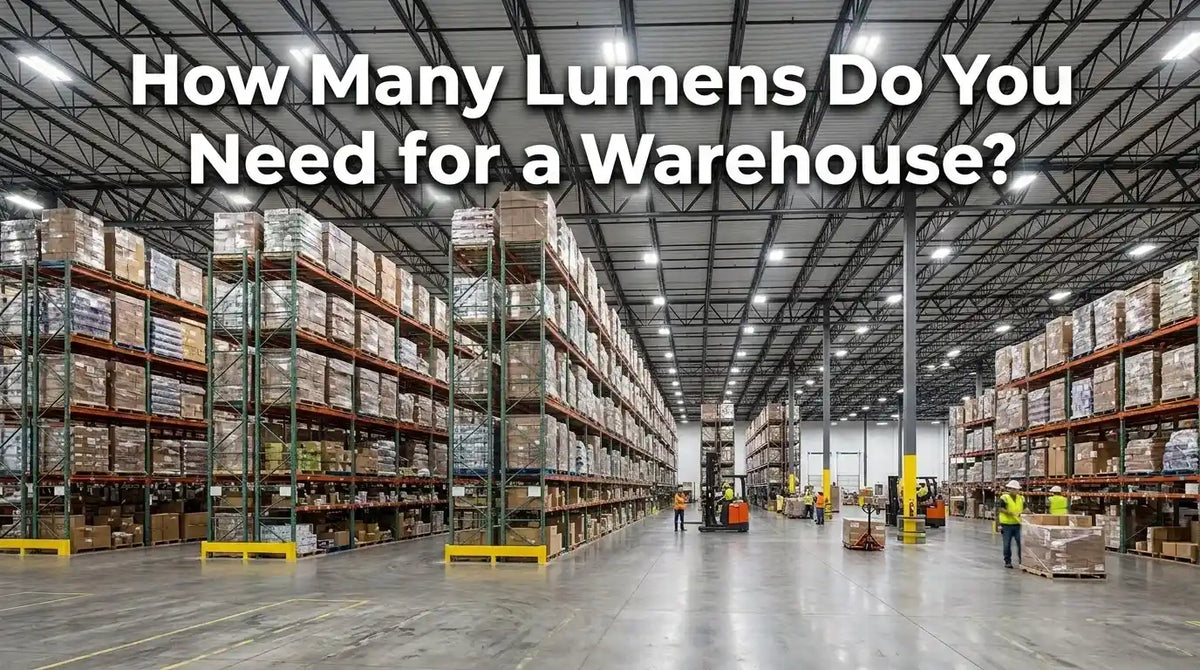
Getting warehouse lighting right is more important than simply choosing the brightest fixtures available. Too little light can make aisles, shelves, loading areas, and workstations difficult to see. Too much light can create glare, waste energy, and increase operating costs.
The right Warehouse Lighting Lumens depend on several factors, including the size of the building, ceiling height, type of work being performed, fixture placement, and the level of illumination needed at the floor or work surface.
For many warehouse applications, a useful starting point is to calculate the required foot-candle level and multiply it by the total square footage. From there, you can determine how much total lumen output the space needs and how many LED fixtures will be required.
What Are Lumens in Warehouse Lighting?
Lumens are a way to count the total visible light coming from a lamp. Put simply, when the lumen number goes up, the light level usually goes up too.
This is different from watts.
Watts measure how much electricity the fixture uses. Lumens measure how much light the fixture puts out. This matters because many newer LED fixtures can give strong brightness while using less power than older systems, like metal halide, fluorescent, or high pressure sodium.
For example, two LED high bay lights may both consume 150 watts, but one could produce 20,000 lumens while another produces 24,000 lumens. The second fixture provides more light from the same power consumption.
That is why warehouse buyers should pay attention to both lumen output and fixture efficacy, which is usually expressed as lumens per watt.
How Many Lumens Does a Warehouse Need?
There is no single lumen requirement that works for every warehouse.
A storage location that is not a high-traffic warehouse typically requires less lighting than a warehouse where people are picking products, reading labels, inspecting parts or using machinery.
Typical planning ranges may look like this:
| Warehouse Area | Typical Light Level |
|---|---|
| General storage | 10–20 foot-candles |
| Open warehouse areas | 20–30 foot-candles |
| Picking and packing zones | 30–50 foot-candles |
| Loading and receiving areas | 20–30 foot-candles |
| Detailed inspection areas | 50+ foot-candles |
These figures should be treated as general planning guidelines rather than fixed requirements. The correct warehouse light levels will depend on the actual work being performed, the facility layout, applicable codes, and project-specific safety requirements.
A warehouse used primarily for bulk storage may perform well at the lower end of the range. A distribution center with workers reading small product labels may require noticeably more light.
How to Calculate Warehouse Lighting Lumens
A simple way to estimate the amount of light needed is:
Total Lumens = Warehouse Square Footage × Required Foot-Candles
Suppose you have a 10,000-square-foot warehouse and you want approximately 30 foot-candles of illumination.
The equation will be as follows:
10,000 × 30 = 300,000 lumens
It would mean 300,000 lumens as a minimum requirement.
However, actual application of lighting design is not always that simple.
Various factors such as mount height, beam spread, spacing, height of shelves, wall reflection, and light loss might affect the total quantity of light received on the floor.
For that reason, a calculated lumen total should be considered an initial estimate rather than a final lighting layout.
Warehouse Lumens Per Square Foot
When people search for warehouse lumens per square foot, they are often trying to determine how much light is needed for a specific building size.
A foot-candle means one lumen on each square foot of the lit area. So the math is direct.
For instance:
- 10 foot-candles equals roughly 10 lumens per square foot
- 20 foot-candles equals roughly 20 lumens per square foot
- 30 foot-candles equals roughly 30 lumens per square foot
- 50 foot-candles equals roughly 50 lumens per square foot
Keep in mind that fixture lumens are measured at the light source, while foot-candles describe the light reaching a surface. Not every lumen produced by a fixture reaches the warehouse floor.
That is why mounting height and fixture optics matter so much.
Warehouse Lumens by Ceiling Height
Ceiling height plays a major role in fixture selection.
10–15 Foot Ceilings
Warehouses with lower ceilings usually require lower-output fixtures with wider light distribution.
Using excessively powerful high bays at this height can create bright spots and uncomfortable glare.
15–25 Foot Ceilings
This is a common mounting range for commercial warehouses and distribution facilities.
Medium- to high-output LED high bay fixtures are often used because they can deliver good coverage while maintaining useful light levels across aisles and open areas.
25–40+ Foot Ceilings
Tall warehouses require more careful planning.
Fixtures may need higher lumen output along with narrower or more controlled beam patterns to direct light toward the floor instead of spreading too much light across the upper portion of the building.
In these environments, simply increasing wattage is not enough. Optics and fixture spacing become increasingly important.
How Many Lumens Should an LED High Bay Light Have?
LED high bay fixtures are available in a wide range of lumen outputs.
For some setups, the usable output can fall in these ranges:
- About 10,000 to 15,000 lumens. This is often for smaller rooms or when the light is mounted lower.
- About 15,000 to 25,000 lumens. This is more typical for many commercial warehouses where fixtures sit at mid height.
- Around 25,000–40,000+ lumens for tall ceilings and larger industrial spaces
The right choice depends on more than brightness alone.
A 30,000-lumen fixture may sound better than a 20,000-lumen fixture, but it may not be the best option if it creates glare, uneven illumination, or excessive brightness directly below each fixture.
Proper warehouse LED brightness comes from balancing lumen output, mounting height, spacing, beam distribution, and the activity performed in the area.
Lumens vs. Watts for Warehouse Lighting
One of the most common mistakes when replacing older warehouse lights is selecting new fixtures based only on wattage.
Older lighting systems were often discussed primarily in watts. For example, a facility might have used 400-watt metal halide high bays and assume that a new LED system also needs a similar wattage.
That is not the best comparison.
With LED technology, the important measurement is how much usable light the fixture produces for the power it consumes.
A more efficient LED fixture can produce the required lumen output while using considerably less energy.
For comparison, look at:
- Total lumens
- Lumens per watt
- Beam angle
- Mounting height
- Fixture distribution
- Dimming capability
This gives a much better picture of real lighting performance.
Factors That Affect Warehouse Lumen Requirements
Several conditions can change how much light your warehouse actually needs.
Warehouse Size
Larger warehouses naturally require more total lumen output, but total square footage alone does not determine the number of fixtures.
Ceiling Height
With an increase in mounting height, there is an increase in the distance for the fixture to throw light. Optics will assist in keeping the useful illumination on the floor.
Work Type
Storage areas have lower lighting requirements compared to picking, packing, inspection, assembly, or quality control areas.
Racking and Aisle Width
Higher racking tends to create shadows whereas narrow aisles may need more focused light distribution.
Reflectance of Surface
Highly reflective walls and floors give higher illumination when compared with dark surfaces. Dark warehouses need more light output for the same illumination.
Fixture Spacing
Fixtures placed too far apart can create dark spots. Fixtures placed too close together can cause unnecessary brightness and increase energy consumption.
How Many LED High Bay Lights Does a Warehouse Need?
Once you know the approximate total lumen requirement, you can make an initial estimate of fixture quantity.
Use this simple formula:
Number of Fixtures = Total Required Lumens ÷ Lumens Per Fixture
For example, if your warehouse needs approximately 300,000 lumens and each high bay fixture produces 20,000 lumens:
300,000 ÷ 20,000 = 15 fixtures
That gives you a starting estimate of 15 fixtures.
However, the final number may change once mounting height, beam angle, rack layout, aisle width, and fixture spacing are considered.
For larger commercial projects, a photometric layout is often the better approach because it shows how light will actually be distributed throughout the space.
Choosing the Right LED Warehouse Lighting
When you compare warehouse fixtures, do not only look at the lumen number. Think about other parts, too:
- Required lumen output
- Lumens per watt
- Ceiling height
- Beam angle
- Color temperature
- Color rendering index
- Dimming capability
- Motion or occupancy sensors
- Fixture mounting method
- Environmental rating
- Product certifications
For many facilities, LED High Bay Fixtures are a practical solution because they are designed specifically for high-ceiling commercial and industrial environments.
Linear high bays may work especially well in aisle-based layouts, while UFO-style high bays are often suitable for open warehouse areas.
Common Warehouse Lighting Mistakes to Avoid
A good lighting layout should provide consistent visibility without wasting energy.
Common mistakes include choosing fixtures based only on wattage, using too few extremely bright fixtures, ignoring ceiling height, and spacing lights too far apart.
Another problem is focusing only on open floor areas while overlooking aisles, loading docks, shelving, and workstations.
Too much light can be a problem too. Just adding more lumens will not always make the space feel better. If the brightness is too high, you may get glare. It can also waste more power and make some work feel hard on the eyes.
You want an even level of light across the area. It should feel steady, not harsh in one spot and dark in another.
FAQs About Warehouse Lighting Lumens
How many lumens in a square foot are necessary for a warehouse?
Most warehouses require around 10 to 50 lumens/sq. ft., depending on their activities. Shelves and storage areas usually need less lighting, while areas for picking, packing, and inspection usually need more.
How many lumens do I need for a 10,000-square-foot warehouse?
If you are aiming for 30 foot-candles, a simple estimate is near 300,000 lumens. The real total from the fixtures can be different. It depends on the layout, the height of the lights, and how the light spreads.
How many lumens should a high bay light produce?
Many LED high bays produce anywhere from roughly 10,000 to 40,000 lumens or more. The appropriate output depends primarily on ceiling height and required warehouse light levels.
Is it ideal to use 5000K for warehouse lighting?
The lighting with 5000K is mostly used in warehouses as it creates a bright cool white color appearance. However, some warehouses may require 4000K
How many LED high bay lights do I need?
Divide the estimated total lumen requirement by the lumen output of each fixture to get a starting quantity. A proper lighting layout should then account for mounting height, spacing, beam angle, and obstructions.
Closing Thoughts on Warehouse Lighting Lumens
Warehouse lighting lumens should be chosen based on the provision of useful light and not the brightest available lights.
First, assess the size of the warehouse and determine the desired foot candles. Also factor in height, racks, fixture placement, optics, and the work performed within each space.
Once you understand the required warehouse lumens per square foot, you can compare LED high bay fixtures based on lumen output, efficiency, and light distribution.
The right combination of warehouse LED brightness and properly planned warehouse light levels can improve visibility, support safer working conditions, and reduce unnecessary energy use while giving the facility consistent lighting where it matters most.