
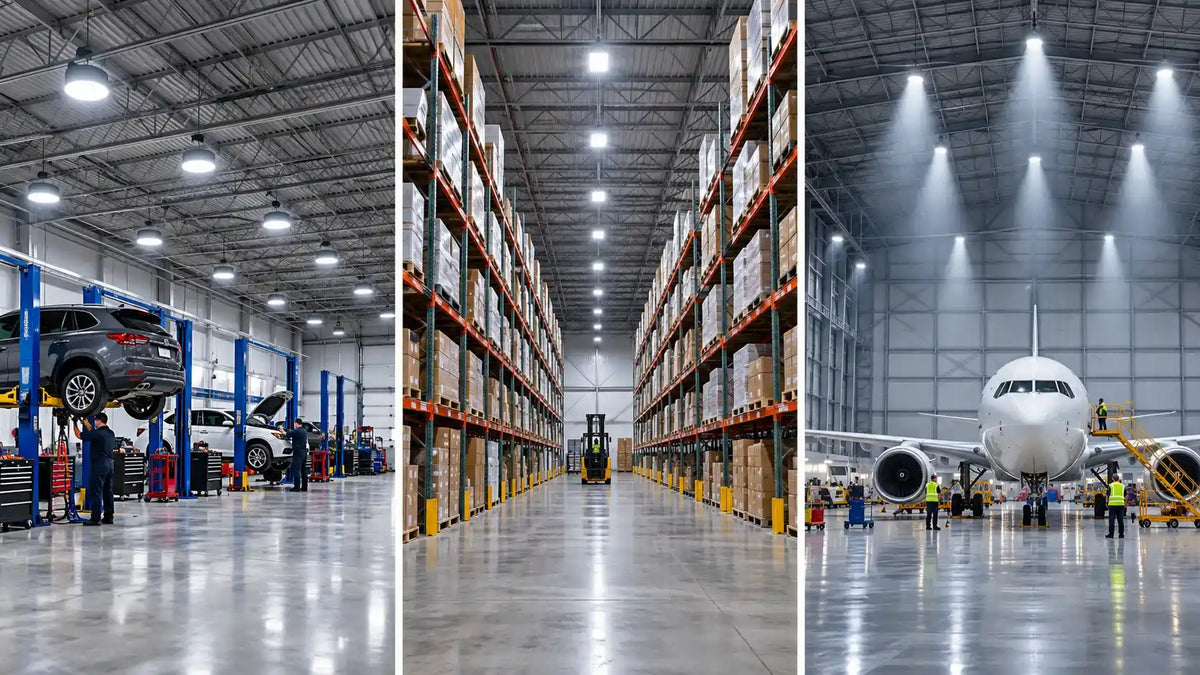
Choosing the right High Bay Lights by Ceiling Height is one of the most important decisions you will make for any large indoor space. Get it wrong and you end up with dim corners that create safety hazards, or you spend far more than you need to on fixtures that are simply too powerful for your building. Get it right and your space becomes brighter, safer, more productive, and noticeably cheaper to run.
This guide walks you through exactly what you need for three of the most common commercial and industrial ceiling heights: 20 feet, 30 feet, and 40 feet. Whether you are fitting out a workshop, a warehouse, a distribution center, or a sports facility, the recommendations below will give you a clear and confident starting point.
Why Ceiling Height Changes Everything
Most people shopping for commercial lighting naturally focus on wattage. That instinct makes sense, but wattage alone tells you very little about whether a fixture is right for your space. What actually matters at the floor level is foot-candles, which is the measure of how much light lands on a surface. The higher your ceiling, the more distance that light has to travel, and the more it spreads and loses intensity before it reaches the people and surfaces below.
Think of it as being similar to shining a flashlight onto the floor. You hold it a foot from the floor and see a brightly lit circular spot of light. When you raise the flashlight five feet from the floor, you see the same circle but much larger and with less intensity of light. This is how high bay lighting mounting height operates.
This is why a 100W fixture that performs brilliantly in a 20 ft workshop would be nearly useless hanging at 40 feet. The numbers have to match the height, not just the floor area.
Key Numbers to Understand Before You Buy
Before looking at specific ceiling heights, it helps to understand the three numbers that drive every good high bay lighting decision.
Lumens are the total amount of light a fixture puts out. This is the number that matters most when comparing fixtures because it measures actual output, not energy draw.
Foot-candles: The foot-candles refer to the intensity of the light that reaches the working surface. A general warehouse needs about 20 to 30 foot candles. More precise assembly and inspection areas would require at least 50 foot candles. Simple calculation of the number of lighting units needed can be achieved by multiplying the square footage of your floor by your required foot-candles and dividing the result by the lumens per lighting unit.
Beam angle: This refers to how wide the light beam is. It determines how much light illumination is provided. The most effective beam use is when lighting equipment is placed at a low height above ground. At higher mounting heights, a narrower beam is preferred since the light would go straight down and not outwards to nowhere.
High Bay Lights for a 20 Foot Ceiling
A 20 ft ceiling is the entry point for high bay lighting territory. At this height, standard commercial downlights start to fall short, but you do not yet need the heavy industrial fixtures designed for extreme heights. This is actually one of the most flexible height brackets to work with.
Power rating: between 100W to 150W LED.
Recommended lumen output: 13,000 to 20,000 lumens per fixture.
Beam angle: 90 to 120 degrees.
Fixture spacing: 12 to 15 feet on center.
The shorter distance of the fixture to the floor can accommodate a wider beam angle in this case. A 120 degree coverage means a bigger area can be covered using fewer fixtures, resulting in lower installation time and costs.
UFO style round high bays are an excellent fit at this height. They are compact, efficient, and widely available in the right wattage range. Linear high bays also work well here, particularly in spaces with rack storage where light needs to reach between aisles rather than spreading evenly across an open floor.
Common spaces in this bracket include auto repair shops, small to mid sized warehouses, fitness studios, retail back of house areas, and light manufacturing facilities. For most of these applications, a 150W UFO high bay delivering around 19,500 lumens will give you solid, even coverage without over engineering the installation.
One thing to watch at 20 feet is glare. Because the fixtures are relatively close to eye level compared to taller ceilings, it is worth choosing fixtures with frosted lenses or built in glare guards, especially in workspaces where people spend long periods looking upward at shelves or racks.
High Bay Lights for a 30 Foot Ceiling
At 30 feet, the math changes significantly. That extra ten feet of distance means the light has much more room to scatter before it reaches the floor, so you need more lumens to achieve the same foot-candle level at ground level. This is where 30 ft warehouse lighting decisions get serious.
Suggested wattage: 150W to 200W LED
Recommended lumen output: 20,000 to 26,000 lumens per unit
Beam angle: 60° to 90°.
Spacing between fixtures: 15 to 20 ft, measured center to center.
Since it’s being mounted at this height, it is best to make the beam narrower. With a wider spread of 60° to 90°, the light falls more directly to the floor. This allows more lumens to fall on the floor rather than on the side walls first. Coverage is good but not messy.High output UFO high bays in the 185W to 200W range are the most popular choice for 30 ft spaces. Many of them offer interchangeable optic attachments, so you can select a 60 degree or 90 degree lens depending on whether your space is open plan or divided by shelving and racking.
Linear high bays with narrow secondary optics are another strong option for 30 ft warehouses with long aisles. They throw a more rectangular pattern that follows the aisle direction, which is far more efficient than a round fixture trying to light a narrow corridor from above.
Typical spaces in this bracket include distribution centers, manufacturing floors, big box retail environments, and multi purpose sports facilities. For a standard distribution warehouse at 30 feet, aim for at least 20 foot-candles at floor level, rising to 30 or more in areas where workers need to read labels or pick small items accurately.
High Bay Lights for a 40 Foot Ceiling
A 40 ft ceiling is where lighting becomes genuinely challenging and where the difference between a well chosen fixture and a poorly chosen one becomes most visible. At this extreme height, under powered fixtures simply cannot deliver usable light to the floor. The result is a space that looks lit from a distance but feels dim and flat at ground level.
Recommended wattage: 200W to 320W LED (industrial grade fixtures can go higher)
Recommended lumen output: 26,000 to 45,000 lumens per fixture
Beam angle: 45 to 60 degrees
Fixture spacing: 18 to 25 feet on center
At this mounting height, it helps to keep the beam tighter. With a wider 60° to 90° spread, the light drops more straight down. That way, more of the lumens land on the floor instead of hitting the side walls first. Coverage is still solid, just less messy. The result is a more even pattern with better use of the light.
Fixtures at this height need to be purpose built for industrial environments. Look for high power UFO high bays with robust thermal management, since sustained high wattage output in demanding environments requires a housing and heat sink design that a standard commercial fixture simply does not have. Die cast aluminum housings with wide fin arrays are a good indicator of a fixture built for the long haul.
40 ft ceiling applications include aircraft maintenance hangars, steel fabrication plants, large scale fulfillment warehouses, and indoor arenas. In these environments, the consequences of poor lighting go beyond productivity. Safety depends on workers being able to see clearly at all distances, including floor level detail work and elevated equipment they are operating from below.
Maintenance is also something to consider. At this distance, changing your fixtures will be a difficult task, but opting for high-quality fixtures with rated lives of 100,000+ hours and good warranties is very much worth it.
Three More Factors Worth Considering
Reflectivity of your interior surfaces
Light colored walls and ceilings reflect light back into the space, improving overall brightness without adding fixtures. A warehouse with white painted walls can achieve the same foot-candle level at the floor with fewer or lower wattage fixtures compared to one with dark unpainted concrete walls.
Dimming controls and occupancy sensors
By integrating high-bays with either motion sensors or daylight harvesting controls, energy savings can reach between 30 and 50 percent at all three heights since the spaces are only occupied occasionally. Most quality LED high bays today include 0 to 10V dimming compatibility as a standard feature.
Utility rebates
There are many LED high bays that qualify for rebates due to their energy efficient performance under the utility programs run locally. Normally, DLC listed products have to be installed for rebate qualification. Therefore, you should ensure that the products are included in the DLC list prior to making a decision on the products that are being offered at your location.
Frequently Asked Questions
Does 150W high bay fixture work at 40 feet?
No, not usually. The 150W fixture will look like an adequate solution at 40 feet, but its light output will still be too low to meet your safety standards. At 40 feet, the light will spread and weaken a lot.
How many high bay lights do I need for a 10,000 sq ft warehouse at 30 feet?
Assuming a target of 25 foot-candles and fixtures producing 20,000 lumens each: 10,000 sq ft x 25 foot-candles = 250,000 lumens needed. Divide by 20,000 lumens per fixture = 13 fixtures as a starting estimate. Always add a 10 to 15 percent buffer for real world efficiency losses.
Is a UFO high bay or linear high bay better?
UFO high bays suit open floor plans and spaces with high turnover of floor layouts. Linear high bays are better for aisle based storage facilities where a directional, elongated light pattern improves aisle visibility without wasting light on walls.
Which color temperature should I use for a warehouse?
Most often, 5000K color temperature is used in warehouses and distribution centers, because the cooler light increases contrast and allows one to easily read the labels and discern the colors of objects. If you need a warmer light for gyms and showrooms, 4000K will work well.
Final Thoughts
Selecting suitable high bay lights based on ceiling height is quite simple as soon as you understand the basic factors involved. Lumens are responsible for taking the light from the fixture. The beam angle controls the direction of light. And, the ceiling height influences the amount that is needed. Consider the suggestions made in this guide as a starting point and make the necessary adjustments for your application needs.
If you are unsure about the right spec for your space, reach out to our team for a free lighting layout consultation. We work with warehouses, industrial facilities, and commercial spaces of all sizes and ceiling heights.